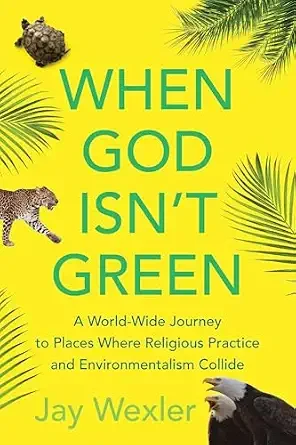
In this lively, round-the-world trip, law professor and humorist Jay Wexler explores the intersection of religion and the environment.
Did you know that
• In Hong Kong and Singapore, Taoists burn paper money to appease “hungry ghosts,” filling the air with smoke and dangerous toxins?
• In Mumbai, Hindus carry twenty-foot-tall plaster of Paris idols of the elephant god Ganesh into the sea and leave them on the ocean floor to symbolize the impermanence of life, further polluting the scarce water resources of western India?
• In Taiwan, Buddhists practicing “mercy release” capture millions of small animals and release them into inappropriate habitats, killing many of the animals and destroying ecosystems?
• In Central America, palm frond sales to US customers for Palm Sunday celebrations have helped decimate the rain forests of Guatemala and southern Mexico?
• In New York, Miami, and other large US cities, Santeria followers sprinkle mercury in their apartments to fend off witches, poisoning those homes for years to come?
• In Israel, on Lag B’omer, a holiday commemorating a famous rabbi, Jews make so many bonfires that the smoke can be seen from space, and trips to the emergency room for asthma and other pulmonary conditions spike?
Law professor and humorist Jay Wexler travels the globe in order to understand the complexity of these problems and learn how society can best address them. He feasts on whale blubber in northern Alaska, bumps along in the back of a battered jeep in Guatemala, clambers down the crowded beaches of Mumbai, and learns how to pluck a dead eagle in Colorado, all to answer the question “Can religious practice and environmental protection coexist?”
Buy When God Isn’t Green at Beacon Press or IndieBound
“Boston University law professor Wexler offers a highly entertaining and eye-opening look at situations where freedom of religion and environmental protection clash. From harvesting palms in Guatemala and Mexico for Palm Sunday to the massive burnings of joss in Singapore, Wexler portrays both sides of the debate as sympathetic and deserving of fair treatment. For example, should whaling (when practiced within reason) be allowed for the Inupiat people, for whom the Nalukataq whale hunt not only provides enormous quantities of resources but also serves as a powerful aspect of their religion? Wexler is often lighthearted in tone, but he conveys the gravity of harming either the environment or the vitality and vibrancy of a religious culture with uncritical legal regulation. Though he directs this work mainly toward governments and nongovernment organizations, religious and secular readers alike will find much to enjoy and appreciate in this fascinating travelogue of worldwide religious practice and the legal, economic, and social systems that make environmental protection difficult to enforce.”
—Publishers Weekly
“Witty and engaging, this book simultaneously celebrates and challenges spiritual traditions…Wexler’s prose is clear and respectful, and he avoids both the shrill anger of a radical and the dry academic language of the law school classroom. He combines prescient legal anecdotes with self-effacing humor, such as when he brought a small plastic fork to carve a hunk of whale meat.”
—Kirkus Reviews
“In this engaging and often entertaining tale, a professor travels the world to find out how religion impacts the environment. Though the book establishes the author’s credentials early on, it goes out of its way to be readable and funny, emphasizing the environmental efforts of ordinary people and engaging exactly the way an academic treatise would not. The book’s strategy is clear: speak to those who have an active stake in environmentally conscious religion. It is a winning plan, and even those who have never before considered the environmental impact of worship practices will find themselves engaged.
When God Isn’t Green is frank about the harmful side effects of religious practices, from the Catholic Church’s appetite for tropical palm fronds to the Hindu practice of submerging painted statues of Ganesha in open bodies of water. No tradition is spared, but all are treated respectfully. The result is thought-provoking and educational without ever verging on offensive. Wexler’s argument in favor of government regulation of environmentally unsafe religious practices is sure to spark debate across faith communities.”
—Foreword
“We presume that the Garden of Eden was well tended to, that Buddhist monks are inseparable from the lush landscapes they inhabit, and that fasting during Ramadan must help conserve some resources. The author and professor Jay Wexler disassociates the tangentially conflated schools of religion and environmentalism in “When God Isn’t Green,” a nonfiction book that examines a widespread array of religious practices that happen to cause more harm to the environment than good. It’s a counterintuitive but fascinating prospect—Wexler visits Singapore, Guatemala, India, Alaska, and other locales, imagining how different societies might practice their faith with a closer consideration for the planet on which they worship.”
—The New Yorker (print edition 4/25/16) notice of upcoming event at NYU Bookstore
“If you’ve ever wondered where fronds for Palm Sunday came from or what to do if you find an expired bald eagle, your questions will be answered in this illuminating book.”
—Booklist
“Wexler (Boston Univ. Sch. of Law; Holy Hullabaloos) asks us to set aside what we may think a given religion says about the environment and look instead at the impacts of specific practices. He provides case studies wrapped in a travelog that include seemingly innocuous rituals ranging from Palm Sunday to mercy releases. In addition to detailing some surprisingly deleterious effects of certain ceremonies, Wexler introduces us to believers of all kinds, including green advocates and government regulators. In looking at a wide range of religions—representing most of the major religions as well as indigenous ones—we find that affects are not trivial. Although an atheist, Wexler suggests that readers empathize with both activists and believers. He holds out hope that religious practitioners are sensitive enough to the environment and are sufficiently adaptable to alter their rites to conform within the limits imposed by the world. VERDICT For anyone seeking a comprehensive account of environmental ethics, environmental law, and the role of religion.”
—Library Journal
Lecture on When God Isn’t Green at Virginia Wesleyan University
Reading from my piece “Eagle Party” at the Sanibel Island Writer’s Conference in 2011 (the piece ended up part of the book)